

By Sabri Dibaco
South Sudan has appealed for increased concessional financing, stronger climate resilience support, and expanded private sector investment during the African Development Bank annual meetings in Brazzaville, Republic of Congo.
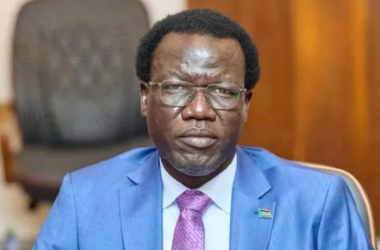
Delivering South Sudan’s statement on behalf of the Minister of Finance and Planning, Daniel Ayulo, the delegation thanked the Government of Congo for its hospitality and praised the African Development Bank leadership for steering Africa’s development agenda during a period of global economic uncertainty.
Johnny Ohisa Damian said the theme of this year’s meeting, “Mobilising Africa’s Development Finance at Scale in a Fragmented World,” reflects the urgent realities facing many African countries, particularly fragile and conflict-affected states.
“For countries like South Sudan, mobilising development financing at scale is not theoretical. It is essential to our survival and progress,” Ohisa Damian stated.
South Sudan noted that although progress has been made in implementing the peace agreement, the country continues to face major economic, humanitarian, and climate-related challenges.
“Our economy remains heavily dependent on oil, making us vulnerable to global price uncertainty and limiting diversification,” Ohisa Damian said.
The delegation warned that climate change is already having devastating effects on communities across South Sudan through recurring floods that continue to displace people, destroy infrastructure, and undermine livelihoods.
The government also highlighted major infrastructure gaps in energy, transport, water, and digital connectivity while emphasising that the country still possesses enormous opportunities in agriculture, renewable energy, regional trade, and human capital development.
“These challenges coexist with immense opportunities in agriculture, energy, regional trade, human capital development, and natural resources,” Ohisa Damian added.
South Sudan commended the African Development Bank Group for its continued support in infrastructure development, agriculture, governance, water and sanitation, institutional capacity building, and resilience programs.
He particularly praised the bank’s contribution toward strengthening food security through climate-resilient agriculture, expanding clean water access for vulnerable communities, and promoting financial inclusion for women and youth.
South Sudan further described the bank’s Transitional Support Facility as a critical financing mechanism for fragile and conflict-affected countries because it provides flexible and timely assistance for both immediate development needs and long-term institutional strengthening.
The delegation called for increased allocations under the African Development Fund, warning that fragile countries risk falling further behind without expanded concessional financing.
“Increased allocation under the African Development Fund and stronger support for sustainability are critical to prevent fragile countries from falling further behind,” Ohisa Damian opined.
South Sudan also appealed for stronger private sector investment through blended finance, guarantees, and risk-sharing instruments capable of attracting investors to frontier markets.
He stressed that climate resilience must remain central to Africa’s development financing agenda, describing climate change as an immediate crisis for South Sudan.
South Sudan further urged development partners to support economic diversification through agricultural value chains, renewable energy expansion, transport corridors, and regional trade integration.
South Sudan reaffirmed its commitment to working closely with the African Development Bank and international partners to achieve sustainable development, peace, and prosperity.
South Sudan became a member of the African Development Bank Group in 2012 after gaining independence in 2011.
Since then, the bank has financed several development programs in infrastructure, agriculture, governance, water supply, institutional strengthening, and resilience-building initiatives.
Despite ongoing economic and humanitarian challenges, including climate shocks, displacement, and dependence on oil revenues, the government continues to pursue reforms aimed at peacebuilding, economic diversification, and regional integration.
The African Development Bank Annual Meetings bring together African finance ministers, central bank governors, development partners, and private sector leaders to discuss economic growth, financing, and development priorities across the continent.