

By Sabri Dibaco
Senior government officials, diplomats, and representatives of international organisations have reaffirmed their commitment to supporting South Sudan’s permanent constitution-making process, emphasising the need for inclusivity, civic education, and sustained political commitment.
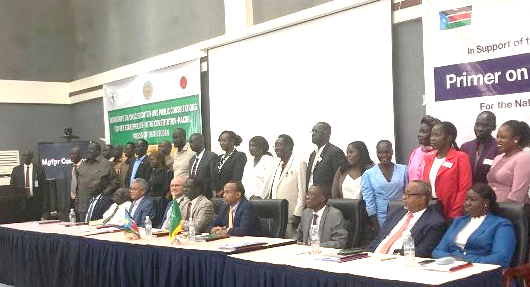
Speaking at the opening of a civic education and public consultation workshop organised by the National Constitutional Review Commission (NCRC) in Juba, the Deputy Special Representative of the UN Secretary-General in South Sudan, Graham Maitland, said the constitution-making process must be owned by the people and not treated as a mere procedural exercise.
“Today’s event marks another important milestone in South Sudan’s journey towards establishing a permanent constitution that reflects the aspirations of its people. These consultations demonstrate a commitment to ensuring that constitution-making is not a box-ticking exercise but a genuinely participatory national undertaking that belongs to all South Sudanese,” Maitland said.
He stressed that the legitimacy of a constitution depends not only on its legal provisions but also on the confidence citizens have in the process through which it is developed.
Maitland urged participants to engage openly and constructively, noting that recommendations emerging from the consultations would inform the work of the Constitutional Drafting Committee and contribute to a constitution that addresses the aspirations and concerns of the people.
The Head of the EU Delegation to South Sudan, Amb. Pelle Enarsson underscored the importance of safeguarding the constitution-making process as the country prepares for elections.
“The work you do and embark on today will matter also after elections and for the future of this country,” Enarsson said.
He noted that while elections provide a snapshot of the political landscape, a constitution establishes the long-term foundation of governance by protecting minority rights, defining the balance of power, and determining the relationship between the executive, legislature, and judiciary.
The EU has supported the NCRC since its reconstitution in 2023 through the Max Planck Foundation, including capacity-building workshops on federalism and civic education activities, according to Enarsson.
Meanwhile, the resident representative of the United Nations Development Programme in South Sudan, Mohamed Abchiir, highlighted the UN agency’s support for the constitutional process over the past four years.
“Every South Sudanese, regardless of age, gender, ethnicity, religion, geographical location, or social status, should have an opportunity to understand the process and contribute their views,” Abchiir said.
He said UNDP, with support from the Peacebuilding Fund and the Kingdom of the Netherlands, has facilitated public consultations across eight states and supported the development of the Women’s Charter and Youth Charter to ensure inclusive participation.
Abchiir added that UNDP also supported the National Federalism Conference and the renovation of NCRC facilities to strengthen the institution’s operational effectiveness.
Chairperson of the NCRC, Dr. Riang Yer Zuor, said South Sudan had deliberately chosen an inclusive and democratic constitution-making process, unlike elite-driven models where constitutions are drafted without public participation.
“Our choice for an inclusive democratic constitution-making process entails wider public participation, which shall require soliciting the views of members of the general public,” he said.
Zuor explained that the constitution-making process is guided by the provisions of the 2018 peace agreement and the Constitution-Making Process Act 2022, both of which emphasise public ownership, inclusivity, and non-exclusion.
He said the commission had completed civic education and public consultations in all ten states and three administrative areas and had now begun consultations with national institutions, including the judiciary, legal associations, and academia.
South Sudan’s permanent constitution-making process is a key provision of the Revitalised Agreement on the Resolution of the Conflict in the Republic of South Sudan (R-ARCSS).
The process is being overseen by the National Constitutional Review Commission under the Constitution-Making Process Act 2022.