


By Yiep Joseph
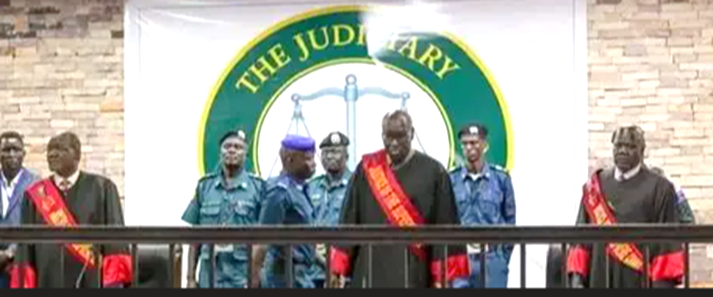
The third accused, Gatwech Lam Puoch, in the ongoing Nasir trial involving First Vice President Dr. Riek Machar and 7 other accused, has denied allegations against him.
He told the court that his actions during the security crisis in Nasir and Ulang Counties were focused on peacebuilding and preventing further violence.
Puoch, a member of the Transitional National Legislative Assembly (TNLA) representing Nasir County on the SPLM/A (IO) ticket, concluded his defense testimony on Wednesday during the 96th session.
In his testimony, Puoch rejected the prosecution’s case and maintained that his activities between 2024 and 2025 were carried out within his constitutional mandate as a parliamentarian.
He said he worked to reduce tensions, encourage dialogue, and seek peaceful solutions following repeated armed confrontations between the South Sudan People’s Defense Forces (SSPDF) and local armed youth in Nasir and Ulang Counties.
The accused outlined several initiatives he said he undertook with other lawmakers to address the deteriorating security situation.
These included raising the matter in Parliament, engaging the public through media platforms, meeting government and military officials, and seeking support from international partners.
Puoch said he used parliamentary procedures to inform national leaders about the insecurity in Nasir County and called for urgent intervention to prevent further loss of life.
He also told the court that legislators representing Nasir and Ulang Counties worked together across political lines to advocate for peace.
According to him, members of Parliament from the two counties jointly appealed to senior government officials, including the president, the first vice president, military leadership, and the United Nations Mission in South Sudan (UNMISS), for support in resolving the crisis.
Puoch further testified that he participated in meetings with military leaders in August 2024, where the causes of the conflict and possible solutions were discussed.
He said the deployment of the necessary unified forces, as provided under the 2018 peace agreement, was considered a possible approach to addressing the security situation.
He told the court that when tensions increased in early 2025 following reports of possible military movements toward Nasir, he attempted to engage senior commanders to prevent further escalation.
Puoch said he contacted Lt. Gen. James Kwang Chol, Governor of Upper Nile State, and Lt. Gen. Jonson Olony Thabo, Assistant Chief of Defense Forces for Mobilisation and Disarmament, urging them to temporarily halt troop movements to allow political leaders to intervene and reduce tensions.
The accused also defended his public statements and press conferences following the February 2025 clashes, saying they were intended to encourage dialogue and support the implementation of the peace agreement.
He challenged the prosecution’s digital evidence presented against him, questioning the authenticity of alleged messages, videos, images, and audio recordings extracted from his mobile phone.
Puoch told the court that his phone remained in the custody of the National Security Service (NSS) after his arrest and raised concerns about the handling of the device and the reliability of the digital materials presented as evidence.
“Criminal responsibility must be proven through clear, credible, and convincing evidence. Suspicion, speculation, and assumptions cannot satisfy that burden,” he told the court.
In his final submission, Puoch asked the court to dismiss the charges against him, affirm his parliamentary immunity, and exclude the disputed forensic report from evidence, arguing that it lacked technical reliability and legal admissibility.
The court adjourned proceedings until Friday, July 17, 2026, when the panel is expected to continue examining the case and consider further applications from the prosecution.