



By Innocent Bidal Emmanuel
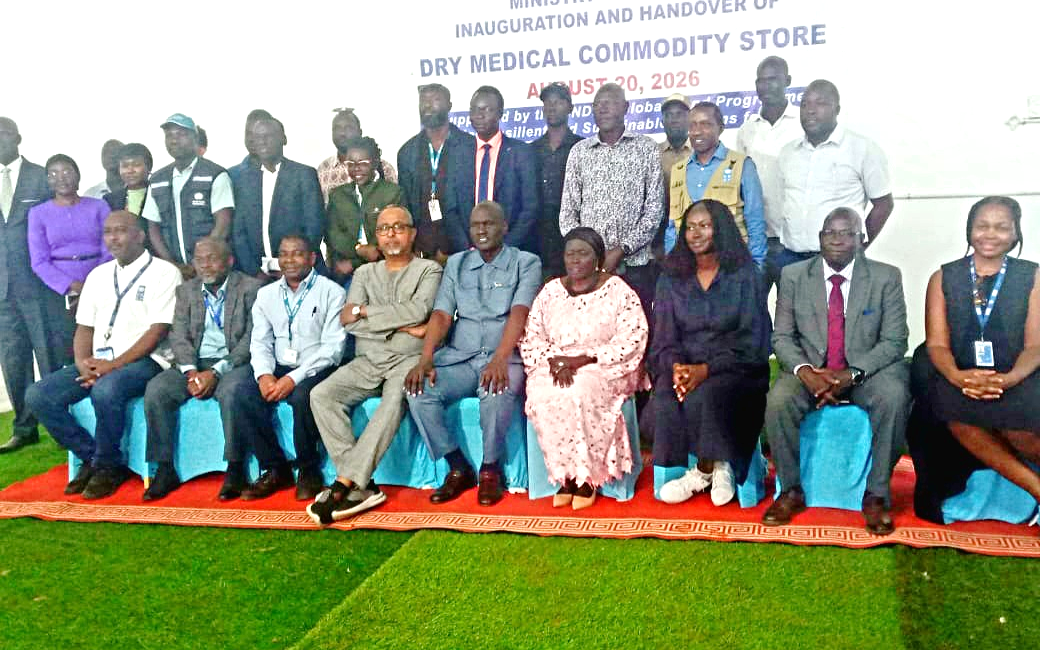
The newly inaugurated Central Medical Store, erected by the United Nations Development Program (UNDP) and the United Nations Children’s Fund (UNICEF), is set to eliminate recurrent skyrocketing costs of renting private warehouses.
Mohamed Abchir, the country’s resident representative for UNDP, said expanding public storage facilities would eliminate the recurring high cost of renting warehouses.
“By expanding public infrastructure, we are structurally eliminating the recurring, high costs of renting private warehousing facilities. The resources saved can now be reinvested where they matter most directly into frontline patient care,” Abchir said during the handover ceremony of Central Medical Store.
The facility, constructed under the Global Fund COVID-19 Response Mechanism (C19RM) grant, adds 1,400 metric tons of expanded storage capacity to the Gumbo Central Medical Store complex.
David Muhia, the chief of supply chain and logistics for UNICEF, said the newly inaugurated Central Medical Store will ease the burden of renting private storage facilities.
“When we bought bed nets, we hired some private warehouses, and it cost about 400,000 US dollars to store bed nets for about 6 months. Supporting the government in terms of strengthening the system will ease the burden,” Muhia said.
“It has been quite a journey for the Health Sector Transformation Project (HSTP) in terms of the amount we pay per year, just for storage alone here in Juba. It is about two million US dollars per year,” he said.
Bortel Ohisa Ekoy, the executive director of the Central Medical Store, urged both the government and international partners to secure resources to further expand storage facilities at the central, state, and county levels.
Ekoy revealed that the facility, which stores HIV and tuberculosis supplies and laboratory reagents, is also designed to provide secure, ideal storage for bulk malaria long-lasting insecticidal nets and dry medical commodities that do not require specialised temperature control.
“The Central Medical Store urged both the government and international partners to secure resources for further expansions; without adequate storage for medical commodities, healthcare delivery remains incomplete,” said Ekoy.
Francis Oromo, the undersecretary of the national ministry of health, said the establishment of a storage facility by the store will address critical gaps in the health commodity supply chain and optimise national storage capacity for essential commodities.
“The storage facility will provide improved storage conditions, strengthen commodity management, and contribute to ensuring that essential medicines and other health supplies are available when and where they are needed,” said Oromo.
The Ministry of Health, in close collaboration with the United Nations Development Programme (UNDP) and the United Nations Children’s Fund (UNICEF), officially inaugurated and handed over a modern dry medical commodities storage facility.