



By Innocent Bidal Emmanuel
Farmers across several regions of South Sudan are facing growing losses as a prolonged dry spell and increasingly unpredictable rainfall threaten crop production, raising fears of worsening food insecurity in 2027.
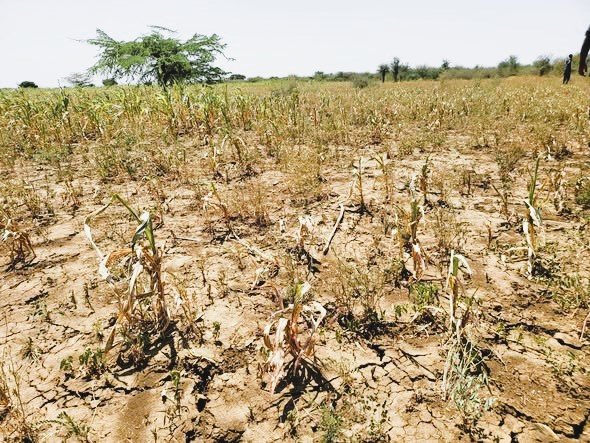
Communities in Greater Bahr el Ghazal, Western Equatoria, and Eastern Equatoria states have reported inadequate and irregular rainfall during the current farming season, leaving crops withered and farmers uncertain about whether they will harvest enough to feed their families.
The situation has affected areas stretching from Lakes State to Northern Bahr el Ghazal, as well as several counties in Western Equatoria and parts of Eastern Equatoria. Farmers say rainfall patterns have become increasingly unreliable, making it difficult to determine the right time for planting.
In some areas, farmers reported receiving rain only twice during the past three months, while other locations have experienced only light and scattered drizzles.
The poor rainfall has raised calls for greater investment in climate-smart agriculture and improved agricultural planning.
Greater Bahr el Ghazal is facing one of its most difficult agricultural seasons in recent years, with farmers reporting widespread crop failure linked to insufficient rainfall.
From Yirol in Lakes State to parts of Northern Bahr el Ghazal, farmers say prolonged dry conditions have severely affected crop growth, threatening household livelihoods and increasing concerns about food shortages.
In Western Equatoria State, farmers have also raised alarm over changing weather patterns. Reports indicate that the January-to-March period has experienced extremely high temperatures for the past three years, creating additional challenges for crop production.
Many farmers who planted groundnuts this year have reportedly expressed disappointment over poor yields, with changing weather conditions blamed for the declining harvest.
In Twic County, a shortage of rainfall has caused crops to wither, particularly in semi-arid areas where farmers depend entirely on seasonal rains.
Jackson Yach Ayuel, the Director of Agriculture in Twic County, said crops planted early had been affected by the prolonged dry conditions and crop pests, resulting in significant losses for farmers.
Similar concerns have emerged from Mayen Adhot Boma in Aweil East County, where communities say their crops have been severely affected by the unexpected lack of rainfall.
Speaking in a phone interview with Aweil News Agency, Chief Majok Ajou warned that the situation could lead to serious hunger in the area in 2027 if urgent assistance is not provided.
He called on the state government to mobilise humanitarian agencies and development partners to support affected communities in Bomas, Payams, and counties across Greater Bahr el Ghazal before the situation worsens.
Meanwhile, Eastern Equatoria State Governor Louis Lobong Lojore on September 3 raised an urgent alarm over the prolonged dry spell affecting parts of the state.
Speaking during a visit to a sorghum farm in Kapoeta South County, Governor Lobong described the situation as alarming, particularly in areas traditionally known as important food-producing zones.
“When I went to Ngauro, which used to be a green place for Greater Kapoeta, what I found there was shocking,” Governor Lobong said. “The Singaita River has dried up, water sources from the Didinga Mountains are disappearing, and now here in Kapoeta South the sorghum in this entire farm has completely withered.”
The governor warned that the failure of this year’s agricultural season could have serious consequences for food security, with many communities already struggling to access food and water.
He appealed to the national government, humanitarian agencies, development partners, and the international community to urgently scale up assistance, including food supplies, water provision, livestock support, and livelihood interventions.
The drought has also disrupted pastoral communities, with livestock reportedly moving across borders and into neighbouring areas in search of pasture and water.
Artisanal miners have also been affected as water sources used in mining activities continue to dry up.
Governor Lobong expressed further concern over reports of deaths linked to hunger and extreme hardship in some communities, including reported cases of suicide in Lafon and other parts of Torit County.
While a scientific assessment of the drought is ongoing with humanitarian and development partners, the governor said the suffering of communities was already evident.
“We should wait for the scientific assessment, but it is already very clear that our people are hungry and they need urgent intervention,” he said.
Women, children, and the elderly are among those most at risk, as many households depend heavily on agriculture and livestock for food and survival.
Communities across the affected regions are now calling on potential donors, humanitarian agencies, and international partners to conduct emergency assessments and establish coordinated drought-response teams.
They warn that without immediate intervention, the prolonged dry spell could destroy livelihoods, deepen food insecurity, and expose thousands of vulnerable families to severe hunger in 2027.