


By Sabri Dibaco
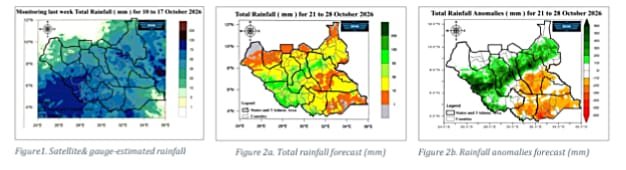
The South Sudan Meteorological Service (SSMS) has forecast moderate rainfall of between 50 and 100 millimeters in parts of the southwestern, southern and southeastern regions of the country, while warning residents of extreme heat-stress conditions on selected days between October 28 and November 4, 2026.
In its weekly weather outlook released on October 28, the service said most parts of South Sudan would experience average temperatures exceeding 28 degrees Celsius, with warmer-than-usual conditions expected across the country during the forecast period.
The meteorological service warned that extreme caution would be necessary on October 28, 29 and 30, as well as November 4, particularly in the central, northern and eastern parts of the country.
“Reduced exposure is advised, particularly during the hottest part of the day. Vulnerable groups should be closely monitored,” the bulletin stated.
The forecast indicates that moderate rainfall is expected in parts of Terekeka, Juba, Lainya, Yei, Morobo and Kajo-Keji counties in Central Equatoria State, as well as several areas in Western Equatoria State.
Other areas expected to receive similar rainfall include southeastern parts of the Greater Pibor Administrative Area and parts of Eastern Equatoria State, including Kapoeta East, Budi, Ikotos, Torit and Magwi counties.
Most other parts of the country are expected to receive less than 30 millimeters of rainfall during the same period.
The service said monitoring conducted between October 17 and 24 showed that most parts of South Sudan had experienced generally wet conditions, with rainfall exceeding 50 millimeters recorded in several counties across the southern, western and central regions.
The outlook also predicts southwesterly winds of between two and five meters per second across most of the country, while stronger winds of up to seven meters per second are expected in much of Eastern Equatoria State.
The meteorological service has advised residents to reduce prolonged exposure to high temperatures, remain indoors or seek shade during the hottest hours, and drink water frequently to prevent dehydration.
It also called for special attention to children, older persons, people with physical disabilities and expectant mothers, who may be more vulnerable to heat-related risks.
“Closely monitor vulnerable groups, including children, older persons, people with physical disabilities and expectant mothers,” the advisory stated.
The service further urged agricultural authorities and farmers to use the rainfall forecast when planning farming activities, monitoring pasture conditions and managing water resources.
Transport and infrastructure authorities were advised to monitor possible rainfall impacts on roads and bridges, particularly in flood-prone locations, while health and emergency services were encouraged to strengthen public awareness and preparedness.
The forecast comes as communities across South Sudan continue to depend on seasonal rainfall for farming, livestock production and water supplies, making timely weather information important for livelihoods and disaster preparedness.
The meteorological service encouraged the public and relevant institutions to continue following its official weekly weather updates for changes in rainfall, temperature and heat-stress conditions.
The South Sudan Meteorological Service, operating under the South Sudan Civil Aviation Authority, provides weather monitoring, forecasts and advisories to support public safety, agriculture, transport and emergency planning.
Its weekly outlooks help communities, government institutions and humanitarian organisations prepare for weather-related hazards, including localised flooding, high temperatures and heat stress.
The latest bulletin covers the period from October 28 to November 4, 2026, and recommends early action by communities and relevant authorities to reduce the potential effects of changing weather conditions.