




By Alan Clement
An economist has blamed cargo delays at the Nimule border for rising fuel prices in South Sudan, warning that supply disruptions are aggravating the country’s already fragile economy.
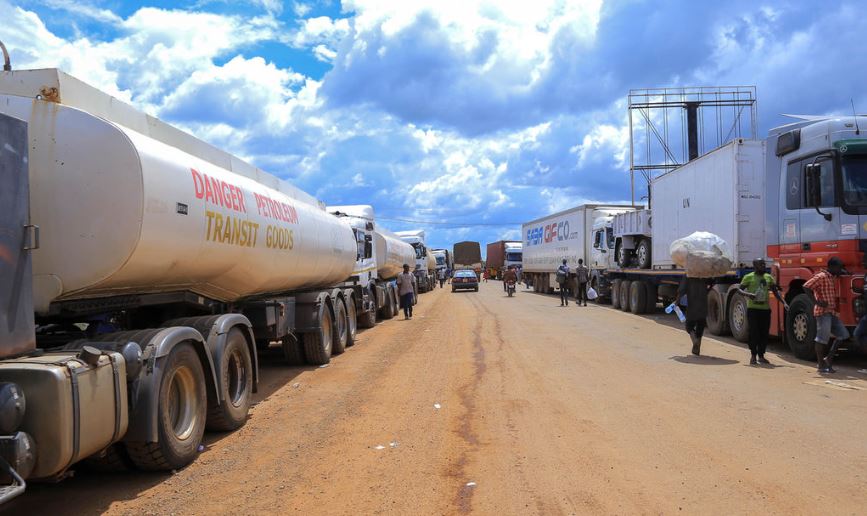
Economist Dr. Abraham Maliet said the growing backlog of trucks carrying goods and fuel into the country has significantly reduced supply in the domestic market, triggering price increases driven by basic demand and supply dynamics.
“There are two things we are talking about; the rise of prices and the cause of that rise,” Dr. Abraham explained adding, “The cause is that there is a backlog of trucks carrying goods and services to South Sudan from neighbouring countries. They are stuck in Nimule.”
According to him, the congestion has been partly caused by delays related to policy implementation at the border, which has slowed the movement of cargo trucks entering the country. “When you delay something, the other end will feel the scarcity,” he said.
According to the economist, the prolonged delays of cargo trucks at the border are already triggering predictable market reactions, as traders anticipate shortages and begin adjusting prices in response to tightening fuel supplies.
“And once scarcity appears, demand goes up. When demand rises and supply is short, prices increase.”
He noted that traders already operating in the market often take advantage of such shortages by increasing prices further, worsening the burden on consumers. However, Dr. Abraham cautioned that the backlog at Nimule may not be the only factor driving the surge in fuel prices.
He pointed to global developments affecting oil markets, saying international conflicts and instability are also pushing up crude oil prices, which ultimately affects the cost of refined fuel imported into South Sudan.
“The world is at war now as you can see. When oil prices go up globally, the price of fuel will also go up,” he said, noting that South Sudan remains heavily dependent on imported refined petroleum products.
Despite these external pressures, he argued that the country’s domestic market structure often magnifies price shocks. He criticized what he described as a persistent pattern where prices rise quickly during shortages but rarely fall once supply stabilizes.
“In South Sudan, we have the opposite of the law of physics,” he said further explaining, “The law of physics says what goes up must come down. But in our market, what goes up never comes down.”
He added that even when goods are available in sufficient quantities, prices often remain elevated because traders assume shortages or maintain inflated prices for profit.
Dr. Abraham also dismissed claims that the recently introduced electronic tax systems are responsible for the current fuel price increases. Instead, he said the country is facing a deeper problem of limited liquidity in the banking system.
“It is not the e-tax system that brought all this,” he explained adding, “The problem is that the country has no cash.”
According to him, many businesses and traders keep large amounts of cash outside the formal banking system, creating liquidity shortages that complicate government efforts to stabilize the economy.
He said policies requiring certain payments in cash were initially intended to encourage businesses to bring money back into banks. “Business people are keeping cash at home or in their offices,” he said.
“So the idea was to encourage them to bring that cash into the banking system by paying taxes,” h added.
However, Dr. Abraham acknowledged that some traders may have exploited the situation, further disrupting supply chains and contributing to the backlog of trucks at the border.
He said resolving the issue would require dialogue between the government and the business community to ensure compliance with financial regulations and restore smooth trade flows.
Beyond the immediate crisis, Dr. Abraham also called for long-term structural reforms to reduce the country’s dependence on imported fuel. He urged authorities to consider investing in domestic oil refining capacity to cushion the economy from global price fluctuations.
“We should build a refinery so we refine our own oil here. That will reduce the pressure of depending on imported fuel,” Dr. Abraham noted.
South Sudan currently exports crude oil but relies almost entirely on imported refined petroleum products, leaving the economy vulnerable to disruptions in regional supply routes and fluctuations in global oil prices.
As cargo delays persist at the Nimule border crossing, analysts warn that continued supply disruptions could push fuel prices even higher, with knock-on effects on transport, food costs and the broader cost of living across the country.