



By Alan Clement
A Central Equatoria county commissioner has warned that parallel authority between security coordinators and commissioners risks creating “two governments” at the local level, as state officials called for unity ahead of anticipated elections.
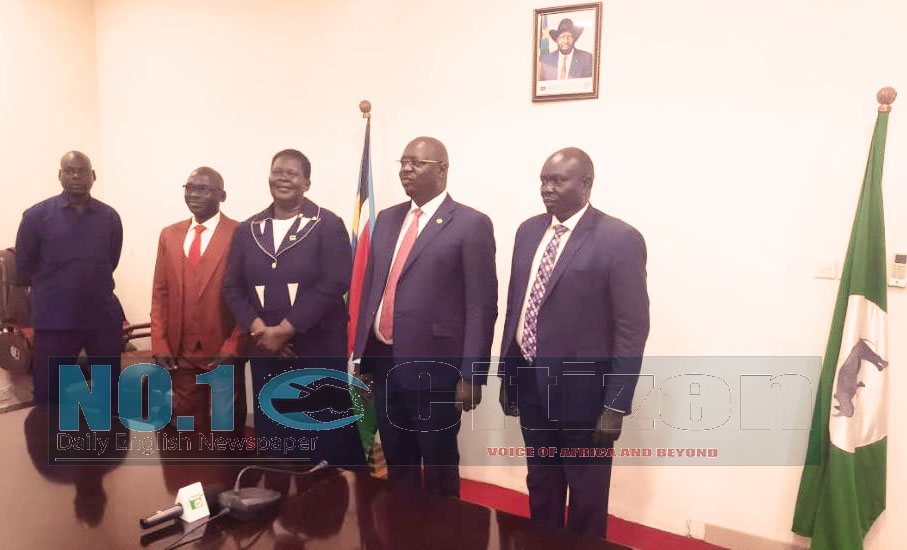
The concerns were raised Monday during the swearing-in ceremony of newly appointed state officials at the State Secretariat in Juba, where leaders acknowledged governance challenges facing county administrations and stressed the need for coordinated leadership across the state.
Speaking during the ceremony, Lainya County Commissioner Huda Micha Laila cautioned that overlapping authority between security coordinators and county commissioners was creating confusion in county administration.
“Another issue is these coordinators. Now you have two governments in the county; the coordinators for security and the commissioners,” Laila said.
She warned that competing lines of authority could result in conflicting reports reaching higher authorities and potentially undermine the effectiveness of local governance.
“The report will come in a different way, but please, our governor, verify the report and give us a chance,” she said, urging state leaders to carefully assess reports originating from the counties.
County commissioners in South Sudan serve as the primary administrative authorities at the grassroots level, responsible for implementing government policies, coordinating with traditional leaders, and overseeing service delivery.
However, security coordinators appointed through security structures often operate in the same administrative spaces, sometimes creating overlapping roles.
Laila suggested that the arrangement could weaken county administration if responsibilities are not clearly defined.
Speaking on behalf of commissioners from the Greater Yei area, she said county officials face challenges that are often less visible than those affecting the capital but are equally pressing. “We are the people of the grassroots. Our problems are more than the problems of Juba County,” she said.
While governance challenges in Juba are more easily identified, she noted that rural counties face broader structural issues, particularly limited services and government presence. Juba has experienced significant population growth over the past decade as people migrate from rural areas seeking security, education, healthcare and employment opportunities.
“Our people are in the diasporas, are in the camps, refugees. Some are in Juba. Juba is very congested,” she noted adding, “These people come from the counties because of lack of services.”
Laila urged national and state authorities to increase support for county administrations in order to strengthen local services and reduce the movement of people toward the capital. “You will not doubt that what you see there will support us. We really need support from the government,” she said.
She also raised concerns about the welfare and discipline of organised forces deployed in rural areas, arguing that lack of support has contributed to misconduct in some communities. She called on the government to strengthen support systems for security forces operating in counties in order to maintain order and improve relations with local communities.
“Our army is a disciplined army, but because we abandoned them, that is why they misbehave in the counties,” she stressed.
The commissioner further linked effective county governance to preparations for upcoming elections, which South Sudan’s leadership has pledged to organise as part of the ongoing political transition.
“We need your support, especially in this crucial time that we are going to confront the election. This election will be different from 2010,” she said.
South Sudan last held national elections in 2010, a year before the country gained independence. Since then, political instability and transitional arrangements have repeatedly delayed fresh elections, leaving many institutions operating under extended mandates.
Government officials, including Central Equatoria Minister of Cabinet Affairs Augustino Ladu Martin, used the swearing-in ceremony to stress unity and integrity, urging newly appointed leaders to work collectively as they take on their roles.
“As we are going to the field of work, work will talk more than we speak,” Martin said adding, “It is better that we take the chance to work together in harmony, understanding each other, keeping integrity among us.”
He emphasised that cooperation within government would be essential for effective administration in the state. “There is a saying that if you want to go far, go together, but if you want to be stubborn, go alone,” Martin said.
“We have come united, and we believe working together will make us take Central Equatoria far,” he added.
The swearing-in ceremony formally introduced the newly appointed officials to their roles within the state government at a time when authorities face increasing pressure to improve governance, expand services in rural areas and prepare institutions for potential elections.
However, the concerns raised by county leaders indicate that structural issues within local administration may need urgent attention if state authorities hope to strengthen governance at the grassroots level.
For Laila, supporting county administrations remains essential not only for service delivery but also for maintaining stability across the state. “If you support us, we will be in the ground. But for me, I want to be in the grassroots, so that we can be together,” Commissioner Laila concluded.