


By Lodu William Odiya
The South Sudan Revenue Authority (SSRA) has unveiled a target of 160 billion South Sudanese pounds per month over the remaining four months of the 2025–2026 fiscal year.
According to SSRA press unit, a senior management leadership meeting convened at its headquarters in Juba to introduce new leadership on Wednesday.
The meeting was also to outline strategic priorities aimed at strengthening revenue collection and institutional performance.
“The Commissioner General announced a target of collecting an average of 160 billion South Sudanese Pounds (SSP) per month over the remaining four months of the 2025–2026 fiscal year” statement partly read.
The top officials of the Authority discussed measures to enhance revenue mobilization, improve accountability, and accelerate modernization efforts nationwide.
The statement stated that the Commissioner for the Domestic Tax Revenue Division, Chol Pual Kur, pledged full support to the new leadership and reaffirmed commitment to the Authority’s core values.
“We pledge to support your leadership. We will stand with you and commit ourselves to the philosophy of SSRA, which is built on transparency, accountability, professionalism, teamwork, and integrity,” Kur said.
“We will utilize a motivated workforce and technology to ensure effective revenue mobilization for the government.”
Meanwhile, the Technical Advisor on Revenue Matters in SSRA, Aggrey Tisa Sabuni, highlighted the importance of responsible revenue management for the benefit of the citizens.
“It is essential that the revenue collected is properly managed for the people of South Sudan,” he noted.
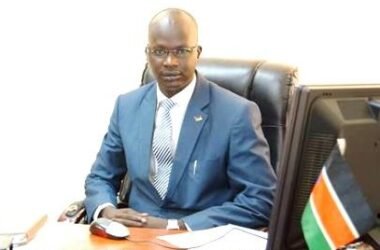
The press unit also underscored that the Commissioner General of the South Sudan Revenue Authority, Amb. Moun Deng Ajuet reiterated the Authority’s mandate to collect revenue in support of national development.
“Our primary responsibility is to collect revenue. We are not a spending agency. Every division, department, and administration must set clear targets, Deng said.
He further directed that 60 percent of the revenue should be generated from the Domestic Tax Revenue Division, while 40 percent should come from customs.
However, to achieve this target, the acting Commissioner for Corporate Services was instructed to ensure the provision of adequate financial resources and workforce capacity across all divisions.
Senior managers were also urged to strengthen collaboration with their teams to enhance performance.
Furthermore, On digital transformation, Amb. Deng called for the expansion of electronic revenue systems to minimize human interference and improve efficiency.
He expressed concern that digitalization efforts are currently limited to Eastern and Central Equatoria states.
“It is my dismay to learn that digitalization is limited to Eastern and Central Equatoria states, while other regions remain left out. This must change,” he stated.
The Commissioner for IT and Digital Transformation, in collaboration with key division heads, has been directed to develop and implement a plan to roll out electronic customs systems in Gok-Machar, Majokyinthiou, Renk, Wunrok, Raja, and Yambio as part of the first phase.
“At the right time, I will visit these areas to witness the operation,” the Commissioner General added.
According to the statement, the SSRA leadership reiterated commitment to enhance transparency, accountability, and efficiency, while accelerating reforms to modernize the nation’s revenue collection systems.