


By Sabri Dibaco
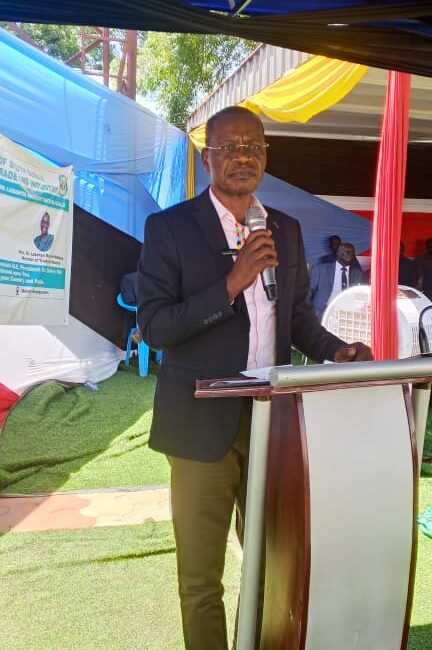
Former Presidential Advisor Joseph Bakosoro has called on the newly appointed Minister of Trade and Industry, Dr. Labanya Margaret, to prioritise strategic planning and production as a pathway to economic stability in South Sudan.
Speaking during a welcoming ceremony attended by national ministers and dignitaries, Bakosoro praised the leadership of President Salva Kiir Mayardit for promoting women into key leadership positions.
He described the transition from outgoing minister Atong Kuol Manyany to Margaret as a reflection of strong and capable female leadership.
“A strong lady has been replaced by another strong lady. That is great,” Bakosoro said, congratulating both leaders.
Bakosoro described the Ministry of Trade and Industry as the country’s “lifeline.” He noted that despite its critical importance, the ministry continues to face challenges due to systemic shortcomings.
Bakosoro urged the new minister to focus less on theory and more on implementation, stressing that South Sudan must urgently rethink its economic approach.
“Can we plan to produce more than we consume? Planning is necessary in every institution. Only then can we comfortably consume what we produce,” Bakosoro emphasised.
He highlighted the importance of long-term national commitment, warning against treating South Sudan as a temporary residence.
“This is our country. We are not displaced people. We must plan well now to ensure a better future,” he stated.
Bakosoro advised the new minister and her team to engage directly with citizens and traders. “Do not sit in offices. Go out and see the suffering of traders along Nimule Road. That is how you will come back with practical solutions.”
On her part, Nyibola Teres, the state minister of trade and industry for Warrap State, emphasised that poor road networks continue to disrupt supply chains, particularly during the rainy season. This disruption leads to shortages and rising commodity prices.
Teres cited a recent incident in Warrap State where a fuel truck overturned due to poor road conditions, resulting in loss of life, injuries, and the blockage of vital transport routes.
“Improving infrastructure is not just about trade; it is about protecting lives and ensuring stability,” Teres stressed.
Despite these challenges, she underscored the country’s vast economic potential, pointing to local products such as shea butter (locally known as Lulu), tamarind, honey, fish, and animal skins, which could be developed into competitive goods for both local and international markets.
To unlock this potential, Teres called for increased investment in value addition, preservation technologies, and training to help communities maximise the benefits of these resources.
She urged the national government to strengthen support for small and medium-sized enterprises (SMEs) through improved access to finance, capacity building, and market linkages.
“By strengthening value chains and promoting value addition, we can move beyond selling raw products and instead produce high-value goods that increase income and improve livelihoods,” Teres stated.
The official welcoming and handover event concluded with unified calls for proactive leadership and a renewed commitment to economic transformation across the country.