



By Sabri Dibaco
The government’s plan to begin implementing mandatory social insurance contributions has met resistance from national employees working across non-governmental organisations (NGOs), private sector companies, and diplomatic missions.
The group called for a temporary suspension of the new directive until key legal and institutional issues are addressed.
The appeal follows the Ministry of Labour’s issuance of Public Circular No. 5/2026, which revoked Circular No. 3/2010 and instructed employers to start remitting social insurance contributions to the National Social Insurance Fund (NSIF).
In a statement released on Wednesday, the National Employees Steering Committee said that while workers fully support the establishment of a national social protection system, the immediate enforcement of the circular is premature because the necessary legal, administrative, and institutional frameworks have not yet been fully established.
“We, the members of the National Employees Steering Committee representing national employees working across NGOs, private sector entities, and diplomatic missions in South Sudan, respectfully write to express the collective concerns of national employees regarding Public Circular No. 5/2026 issued by the Ministry of Labour,” the committee said.
The employees emphasised that they are not opposed to social insurance reform, describing social protection as a critical pillar for safeguarding workers’ welfare and dignity. However, they warned that implementing the scheme before addressing existing gaps could erode public confidence and undermine the objectives of the reform.
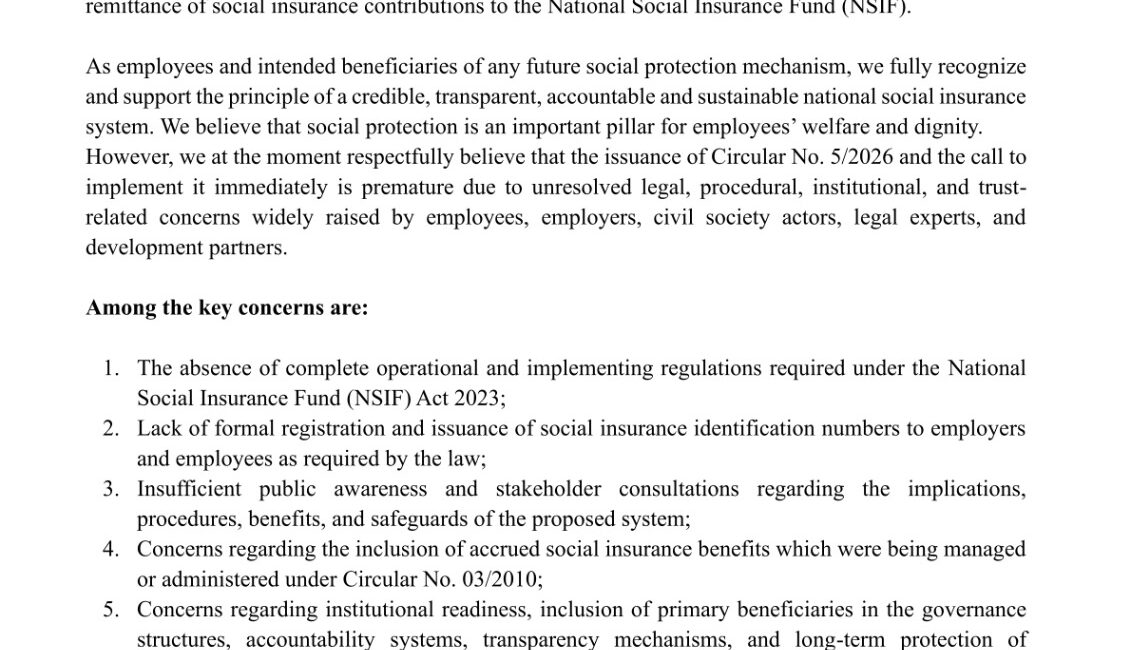
“As employees and intended beneficiaries of any future social protection mechanism, we fully recognise and support the principle of a credible, transparent, accountable, and sustainable national social insurance system. However, we respectfully believe that the implementation of Circular No. 5/2026 is premature due to unresolved legal, procedural, institutional, and trust-related concerns widely raised by employees, employers, civil society organisations, legal experts, and development partners,” the statement added.
Among the concerns raised by the committee are the absence of complete operational regulations under the NSIF Act, incomplete registration systems for employers and employees, limited public awareness about the scheme, and questions over the operational readiness, governance, and accountability of the National Social Insurance Fund.
The committee also called for broader consultations involving employers, labour representatives, professional associations, civil society organisations, and development partners before the policy is enforced. It argued that such engagement would help build consensus and ensure that implementation is transparent, inclusive, and trusted by all stakeholders.
According to the employees, mandatory contributions should only begin once implementation regulations have been finalised, registration systems completed, and adequate safeguards put in place to protect contributors’ rights and guarantee access to future benefits.
The Steering Committee further urged the government to strengthen governance and accountability mechanisms within the National Social Insurance Fund and conduct nationwide public awareness campaigns to educate employers and employees about the objectives, obligations, and benefits of the scheme.
The employees concluded by reiterating that their appeal should not be interpreted as opposition to the government’s reform agenda. Instead, they said they are advocating for a well-prepared and credible social insurance system that is implemented within a sound legal framework and enjoys the confidence of workers, employers, and the wider public.