


By Yiep Joseph
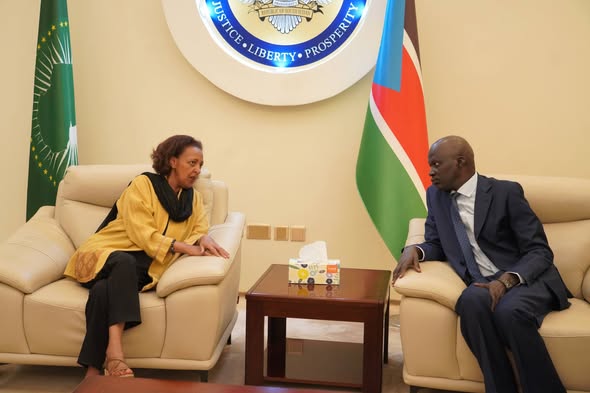
A delegation from the African Union Peace and Security Council has arrived in Juba to engage government leaders on the implementation of the 2018 peace agreement.
According to a statement from the Ministry of Foreign Affairs and International Cooperation, the visit aims to assess the current status of the peace deal and evaluate progress made so far.
The delegation is led by Ambassador Hirut Zemene Kassa, permanent representative of Ethiopia to the African Union and UNECA.
Upon arrival at Juba International Airport, the team was received by Ambassador Kureng Akuei Pac, director general for multilateral relations at the ministry.
The statement noted that the AU delegation will hold meetings with senior government officials and other stakeholders to discuss the implementation of the peace agreement and exchange views on the prevailing security situation in the country.
“The delegation is in South Sudan to engage on the implementation of the peace agreement and to exchange views on the prevailing security situation in the country and other related matters,” the statement partly read.
The visit comes amid growing concerns raised by the Reconstituted Joint Monitoring and Evaluation Commission over the slow and fragile implementation of the Revitalised Agreement on the Resolution of the Conflict in South Sudan (R-ARCSS).
In its recent reports, RJMEC warned that the peace deal has been “severely undermined,” citing continued violations of the permanent ceasefire and increasing clashes between signatory parties.
The monitoring body has also noted that progress on key provisions, including security arrangements, institutional reforms, and preparations for elections, remains slow and uneven, raising concerns about the country’s transition to lasting peace.
Earlier assessments further highlighted systemic challenges, including violations of power-sharing arrangements and stalled implementation of critical reforms necessary for elections and governance.
The transitional period of the peace agreement has already been extended, with elections now expected in December 2026, amid delays in meeting key benchmarks.
In response to these challenges, the government recently moved to adjust the peace framework.
In December 2025, the presidency approved amendments to the peace agreement, a decision later endorsed by the cabinet, aimed at paving the way for elections.
The changes removed provisions that tied elections to the completion of a permanent constitution and a national census process that remain incomplete.