

By Sabri Dibaco
South Sudan and the Russian Federation are moving towards a broader strategic partnership, with both countries preparing a 2027–2029 cooperation action plan aimed at strengthening economic, diplomatic and technical relations.
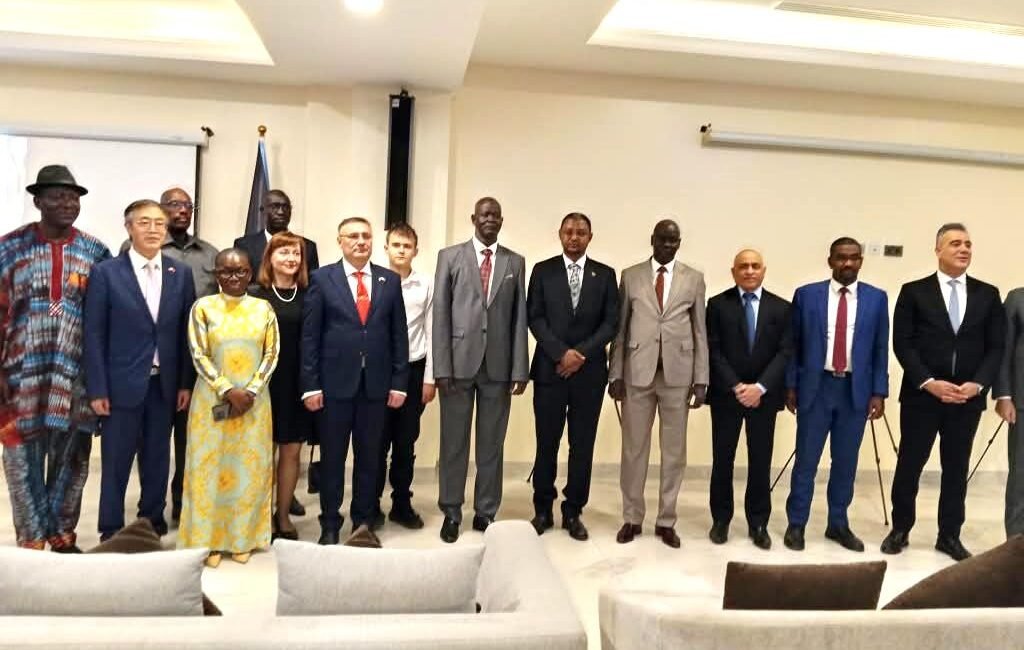
The proposed framework was highlighted during Russia’s National Unity Day celebration in Juba, where the Russian Ambassador to South Sudan, Aleksander Kosmosdemiyanskiy, said recent diplomatic engagements had created new opportunities for expanding cooperation between the two countries.
The ambassador said the relationship between Moscow and Juba had continued to grow through mutual respect, trust and a shared commitment to strengthening bilateral ties.
“Over the past years, we have been establishing cooperation based on mutual respect, trust and a shared commitment to expanding cooperation,” Aleksander said.
He highlighted the importance of high-level engagements between the leadership of the two countries, particularly discussions aimed at identifying priority areas for future cooperation.
According to the ambassador, the engagements had resulted in an agreement to prepare an action plan for developing Russian-South Sudanese cooperation covering the 2027–2029 period.
The proposed plan is expected to provide a framework for implementing joint initiatives, strengthening institutional relations and expanding practical cooperation in areas of mutual interest.
The Russian ambassador also acknowledged the contribution of President Salva Kiir Mayardit to strengthening relations between the two countries, expressing Moscow’s readiness to continue supporting diplomatic engagement with Juba.
He further stressed the importance of establishing a strong legal foundation for bilateral cooperation, including agreements on friendship and cooperation.
The proposed action plan comes as South Sudan seeks to attract foreign investment and strengthen partnerships in key sectors of its economy.
Recent engagements between the two governments have identified petroleum, mining, agriculture, health, education, infrastructure and information technology as priority areas for cooperation.
South Sudan’s caretaker Council of Ministers endorsed plans for strategic cooperation with Russia following President Salva Kiir’s participation in the Third Russia-Africa Summit in Moscow in October 2026.
The Cabinet also called for the development of a 2027–2029 Strategic Cooperation Action Plan supported by a 100-day implementation programme.
The proposed framework is expected to assign responsibilities to relevant ministries, identify priority projects, appoint ministerial focal points and guide technical consultations between the two governments.
The two countries have also moved towards establishing a Joint Intergovernmental Commission on Trade, Economic, Scientific and Technical Cooperation to coordinate bilateral initiatives and identify investment opportunities.
An agreement establishing the commission was signed in Juba on October 30, 2026, by South Sudan’s Caretaker Minister of Petroleum, Awow Daniel Chuang, and Russia’s Minister of Economic Development, Maxim Reshetnikov.
The commission is expected to provide an institutional mechanism for coordinating economic and technical cooperation and supporting the implementation of joint projects.
For South Sudan, the proposed partnership presents an opportunity to explore investment in sectors considered essential for economic recovery, employment creation and infrastructure development.
However, the success of the cooperation framework will depend on how quickly the two governments translate their diplomatic commitments into funded projects and practical implementation.
South Sudan and Russia established diplomatic relations on August 22, 2011. Relations have gained momentum following the opening of the Russian Embassy in Juba and increased high-level exchanges.
The 2027–2029 action plan is expected to guide the next phase of bilateral relations, with both governments seeking to strengthen economic cooperation and establish a more structured partnership