

By Sabri Dibaco
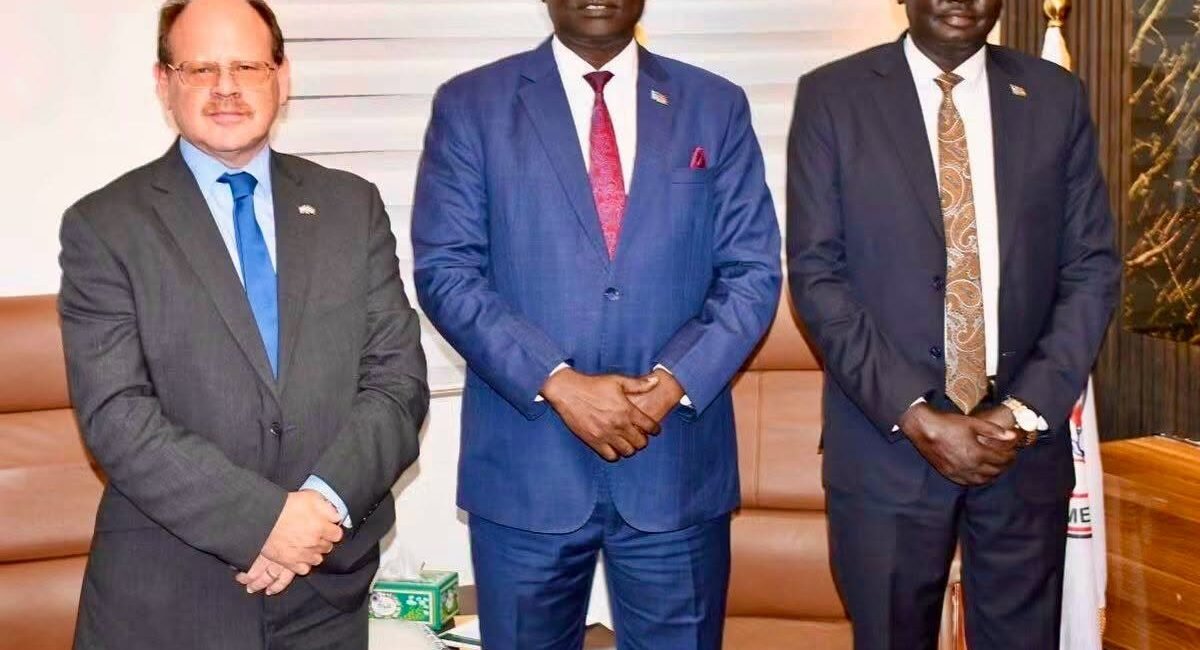
The British Ambassador to South Sudan, David Ashley, has called for stronger protection of humanitarian workers, saying repeated attacks on aid personnel are unacceptable and must be investigated, while urging the government of South Sudan to increase funding for essential public services amid declining international aid.
In a statement issued after meeting the Minister of Humanitarian Affairs, Albino Akol Atak, and the Chairperson of the Relief and Rehabilitation Commission (RRC), Stephen Gach, on Wednesday, Ambassador Ashley said the three officials agreed that humanitarian workers should never be targeted and that perpetrators of attacks must be held accountable.
“I stressed that the frequent killings and abductions of humanitarian workers and contractors in South Sudan this year are utterly unacceptable, whoever the perpetrators,” Ashley said in a statement.
He added that all parties shared a common position on protecting humanitarian personnel.
“The Minister, RRC Chairperson, and I agreed that humanitarian workers should never be a target and on the need for investigations and accountability for all such incidents,” he said.
The ambassador also encouraged South Sudan to join the Declaration for the Protection of Humanitarian Personnel, an international initiative launched by Australia that has already been endorsed by 115 countries.
Ashley reaffirmed the United Kingdom’s commitment to supporting the people of South Sudan, particularly through humanitarian assistance and the delivery of basic services.
“I confirmed that the UK remains a strong supporter of the South Sudanese people and will continue to support health and education services as well as humanitarian response,” he stated in the statement.
However, he warned that shrinking global aid budgets mean the South Sudanese government must increasingly finance its own essential services.
“In the context of declining international aid, I reiterated the urgency of the Government of South Sudan increasingly using its own revenues to support essential services for its population,” Ashley said.
The British envoy further emphasised that lasting peace remains the only sustainable solution to the country’s humanitarian crisis.
“I also emphasised that peace, to be achieved through a resumption of dialogue between the parties to the conflict, was the only sustainable way to reduce humanitarian need and ensure security for all, including humanitarian workers,” he added in the statement.
South Sudan remains one of the world’s most challenging environments for humanitarian operations.
Aid agencies continue to provide life-saving assistance to millions of people affected by conflict, displacement, floods, food insecurity, and disease.
This year, several humanitarian workers and contractors have been killed, abducted or attacked while delivering assistance in different parts of the country, prompting repeated calls from the United Nations, donor governments and humanitarian organisations for stronger protection measures and accountability for those responsible.
The United Kingdom is among South Sudan’s major humanitarian and development partners, providing support for healthcare, education, emergency relief, and peacebuilding initiatives.
International donors have increasingly warned that reductions in global humanitarian funding require the government of South Sudan to assume greater responsibility for financing essential public services while advancing peace efforts to reduce long-term humanitarian dependence.