


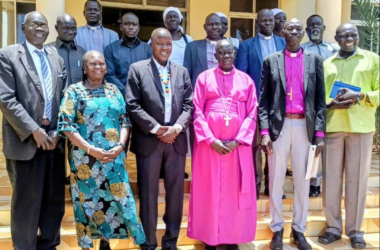


By Dogga Morris
A high-level delegation from South Sudan has concluded a fact-finding mission to Kenya’s Port of Mombasa, a visit that underscores Juba’s commitment to dismantling trade barriers that have inflicted costly delays and financial strain on the business community.
The visit by the high-ranking officials aims to address longstanding issues, including steep container deposits, rogue clearing agents, and insecurity along the vital Nimule-Juba corridor.
Led by Justin Marona, a senior member of Public Accounts and Finance Committee at the Transitional National Legislative Assembly, the delegation engaged in intensive discussions with key port stakeholders.
Other members included Chabur Goc, Member of the Public Accounts and Finance Committee, Mulana Joseph Aleu Chaman, Legal Advisor to the National Assembly’s Public Accounts and Finance Committee and Akeech Tong Malek, Commissioner of Customs Division, South Sudan Revenue Authority.
The talks, hosted by Panda Freight, Logistics and Handling International Ltd team which helps manage South Sudan-bound cargo, sought to streamline the flow of goods to South Sudan, a landlocked nation, which relies heavily on Mombasa as its economic lifeline.
This move comes against a backdrop of recurring trade frictions at the port. Earlier this year, disputes over new tax and invoicing systems introduced by South Sudan Revenue Authority (SSRA) led to cargo congestion and a temporary stalemate.
During the visit, the delegation was taken through the core functions of Panda and the critical role it plays in managing South Sudan-bound cargo.
Traders’ lack of awareness regarding documentation and customs charge timelines was identified as a primary cause of delays and escalating costs.
Mr. Dennis Ombok of Panda emphasized the need for widespread sensitization to mitigate the preventable issues. He added that this lack of awareness often results in delays, added costs, and cargo congestion.
Another major point of contention raised during the discussion was the high-priced container deposits demanded by some shipping lines, which, officials claim, can reportedly reach as high as $10,000.
This fee is much higher compared to the charges on containers destined for other EAC countries.
“For many importers, such fees create significant financial strain, particularly when compounded by delays in returning empty containers. Compounding the issue is the absence of an inland container depot or dry port in Juba, which would otherwise facilitate quicker and more efficient cargo handling,” the statement stated.
This fee, coupled with delays in returning empty containers, a problem exacerbated by the absence of an inland container depot in Juba, which would facilitate quicker and more efficient cargo handling, places a severe financial burden on importers.
Standard rates from major shipping lines for the route are typically lower, suggesting that the higher figure may include additional penalties or fees from third-party agents.
The delegation also briefed on the predatory practices of “unscrupulous clearing and forwarding agents” who defraud importers through inflated and opaque fees, making it nearly impossible for many to clear their goods on time.
In response, the delegation committed to pushing for stronger regulatory oversight to protect South Sudanese traders.
Another concern was the security on the Nimule–Juba corridor, which officials noted, remains a pressing concern.
The delegation acknowledged that fear among Kenyan transporters due to insecurity has led to fewer trucks making the journey and inflated transport costs.
Officials say the issue is compounded by a generally deteriorating security situation in parts of South Sudan, according to recent security reports. They pledged to engage with relevant authorities to enhance safety along the crucial route.
On a positive note, according to the statement, the visit highlighted successful measures that have improved cargo security and monitoring.
The endorsement by the South Sudan government for two specific Container Freight Stations—Compact CFS and Autoport CFS—to handle its cargo was praised for reducing diversion and improving data analysis.
Further, the implementation of the Electronic Cargo Tracking System (ECTS) was lauded as a crucial tool to safeguard goods in transit from being illegally diverted to other countries.
Speaking on behalf of the delegation, Marona affirmed the South Sudanese Parliament’s commitment to addressing the challenges through legislation.
“This mission has been both enlightening and reaffirming,” said Marona. “We return to Juba with a clear understanding of the obstacles our traders face and a renewed commitment to ensuring that South Sudan’s pathway to prosperity is not hindered by inefficiencies or neglect. Mombasa remains central to our economic vision, and we are committed to strengthening this critical link.”
The delegation called for greater collaboration between clearing companies and the South Sudan Chamber of Commerce to keep the business community informed.
They also advocated for a real-time cargo information platform to provide timely updates on vessel arrivals and documentation, ensuring a more transparent and efficient trade environment.