

By Louis Loku
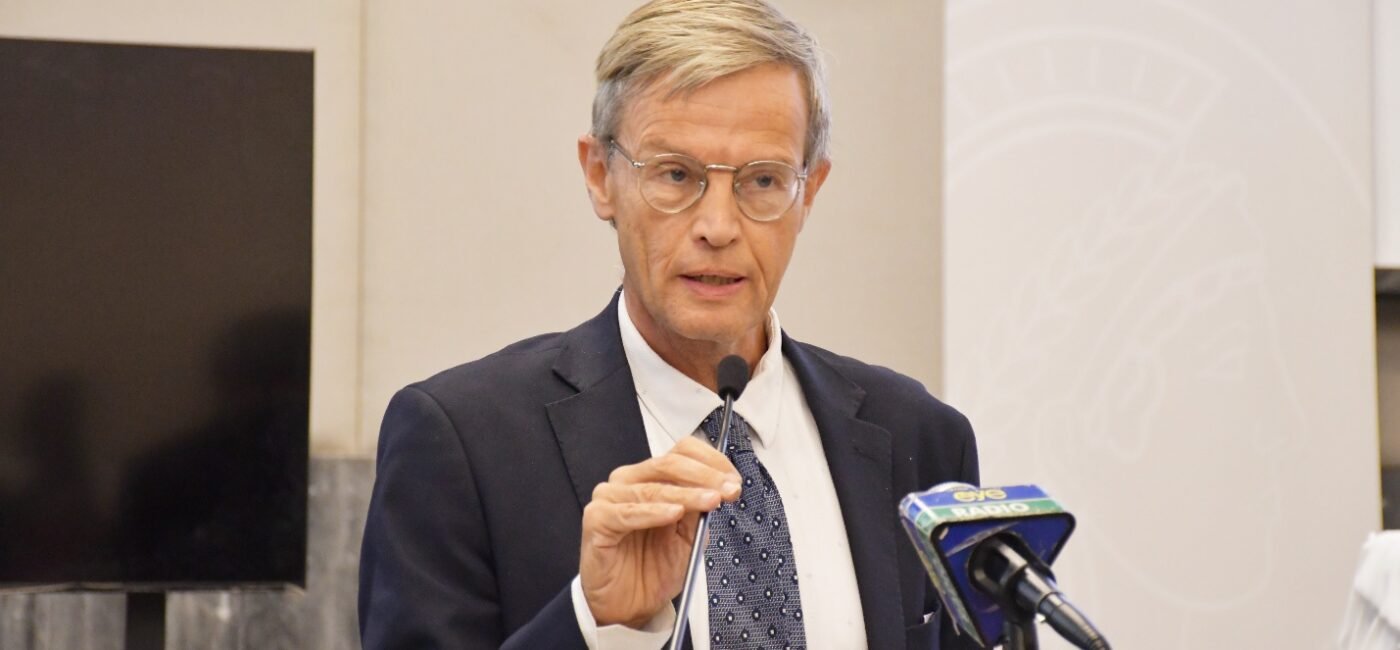
A European Union diplomat in South Sudan, Lothar Jeschke, has questioned the legality of a recent amendment to the Revitalised Agreement on the Resolution of the Conflict in South Sudan (R-ARCSS), saying the required procedure was not followed.
Jeschke said the amendment, which allows the country’s next elections to be conducted under the Transitional Constitution rather than a permanent constitution, should have gone through the process prescribed by the peace agreement.
“Due process for changing the peace agreement was not respected,” Jeschke said on Wednesday during a two-day workshop on civic education and public consultation organised by the National Constitutional Review Commission (NCRC) in Juba.
The workshop is part of the ongoing permanent constitution-making process.
Jeschke said amendments to the peace agreement require the consent of at least two-thirds of the Council of Ministers and two-thirds of the voting members of the Reconstituted Joint Monitoring and Evaluation Commission (RJMEC), followed by ratification by the Transitional National Legislature.
He said the Council of Ministers had given the required approval, but the RJMEC Board was not consulted as required under the peace agreement.
“The RJMEC cannot be bypassed. Things need to be done correctly before any change can take effect,” he said.
Jeschke warned that failure to address the issue could create legal uncertainty over the planned elections.
“Otherwise, we are in a legal limbo, and there will always be doubt hanging over the elections,” he said.
The diplomat acknowledged that holding elections under the Transitional Constitution could be understandable from a practical perspective, given the limited time available to complete the permanent constitution-making process.
However, he said the decision was regrettable because the permanent constitution was one of the commitments contained in the 2018 peace agreement aimed at promoting democratic governance and social cohesion.
Jeschke also welcomed the government’s announcement that outstanding provisions of the peace agreement would be carried forward into post-election arrangements.
He urged the government and other institutions to continue implementing as many outstanding provisions of the peace agreement as possible during the remaining period of the agreement.
The EU diplomat described the constitution-making process as an important opportunity for South Sudan to establish a stable democratic system based on the rule of law, human rights, and accountability.
He said the constitution should serve as a contract between those who govern and the people they govern, giving citizens a framework through which they can demand accountability and claim their rights.
The two-day civic education and public consultation workshop, which began on Wednesday and concludes on Thursday, is part of efforts to increase public understanding and participation in South Sudan’s permanent constitution-making process.
Jeschke urged government institutions and other stakeholders to continue supporting the process, saying South Sudanese deserve a constitution that promotes peace, unity, and democratic governance.
“Please continue to support the process for the people of South Sudan. They deserve it,” he said.