



By Kei Emmanuel Duku
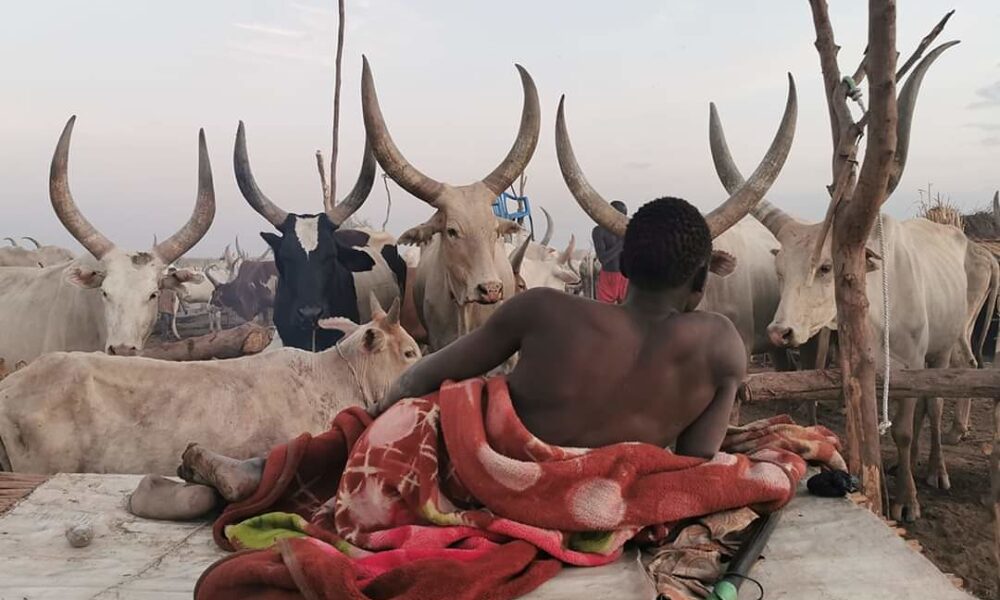
In the heart of South Sudan’s cattle camps, where the air is thick with the scent of wood smoke and the lowing of thousands of cows, an ancient medical ritual unfolds daily that challenges modern healthcare norms. Here, the Mundari people have turned their survival into an art form, utilizing the very waste of their livestock—fresh urine and burnt ash—as a primary defense against pneumonia, skin infections, and the ever-present threat of malaria.
The Mundari people are a Nilotic ethnic group primarily residing in the Central Equatoria State of South Sudan, specifically around the Terekeka County along the banks of the White Nile.
They are world-renowned for their deeply rooted pastoralist lifestyle and their unique, symbiotic relationship with their livestock—specifically the Ankole-Watusi cattle, which are famous for their massive, curved horns.
For the Mundari, the cow is not merely a source of wealth; it is the primary provider of health and hygiene. Regina Kaku, a mother of five children, grew up in the heart of this culture and recounts how the medicinal properties of cow waste are integrated into a child’s life from the moment of birth. In the first month of delivery, Mundari culture dictates that a child cannot be bathed with cow urine or ashes; however, as the child grows from four months to a year, the transition into the camp’s traditional healthcare system begins.
“While in the cattle camp, as parents to the child when you see a cow urinating you will rush with your saucepan, bucket and harvest/collect the cow urine,” Kaku says. “The urine is fresh and warm, straightway you as the mother bath the kid with urine, when the kid has skin rashes and Pneumonia-caused as a result of malaria or too much exposure to cold, it will help in treating and this is why our children of Mundari are always healthy.”
In a landscape where manufactured soap is a luxury, the Mundari utilize the moderate heat of fresh ash to purify the skin. Kaku explains that after the urine bath, the entire body of the baby is smeared with ash burnt from cow dung. She views herself as a living testimony to the efficacy of this tradition.
“Since late 1990’s I have never treated malaria because my life rotate about staying in the camp but of recent since I left the life style of staying in the cattle camp, I became prone to malaria and attacks from other sickness, “she recounts. She notes that there is no specific age limit to this practice because mosquitoes and insects can strike at any time. Even as an adult, she maintains that if she were to return to the camp today, she would bathe in urine and smear her body with ash to stay safe.
The immersion in this lifestyle is total, especially for the elderly. When a cow begins to urinate, it is common to see an elder rush toward the animal to let the warm liquid fall directly onto their head. Once the body is soaked, they turn their back to the sun to dry before applying a fresh layer of burnt ash and dung. This ritual creates a chemical shield that acts as a repellent.
Additionally as the cows swing their tails throughout the night to chase mosquitoes, and the urine acts as a natural deterrent to dangerous insects and snakes, the Mundari believe their large herds provide a safety zone that even chases away wild animals.
This traditional approach extends to the very survival of the most vulnerable individuals. While malnourished children in urban centers are taken to nutrition centers for specialized food, the Mundari transfer underweight infants directly to the cattle site. There, the child is extensively fed on cow milk to complement the mother’s milk. However, the selection of the cow is an accurate cultural science.
“While identifying the cow where the milk will be collected from daily is not anyhow,” Kaku explains. “For example, a cow who gave birth less than 7 days is the one where the milk for the child will be milked from and fed with the kid this is because a cow that recently gave birth and lactating we assume it has more colostrum milk—vitamins, fats or other food values—compared to a cow that has given a month or two ago.”
Kaku notes that if this feeding calendar is followed, a child will regain their weight within two to three months, and nothing will disturb their health. This practice also serves as a critical economic safety net, saving families their little income from buying expensive medicines or supplemental foods.
John Garang, another Mundari pastoralist, reinforces these claims, highlighting that the burnt ashes smeared on the body are essential for hardening the skin against the elements. He explains the process as a deliberate mixture where the burnt ash is combined with the urine before being applied to the human body, whether for a child or an elder.
“This is why you hardly find our children of pastoralist never suffer from malaria,” Garang says. “Even when it rained heavily, the moment we have a destination with fresh ash it is applied on the child’s body and automatically the kid will regain the normal body temperatures and will not suffer from malaria because their skin is hard and resistant to infections and bites.”
According to Garang, the application can happen three to five times a day depending on the level of infection. The warm ash is specifically applied to the knees, arms, and shoulders to strengthen body muscles and encourage infants to start moving and crawling on their own.
He further explained that while a child moving from the village to the camp may initially suffer from diarrhea due to the change in diet, Garang attributes this to a cleansing process.
“The first sip or cup of milk the baby will drink act likes antibiotics that treats the bacterial infections from the baby’s stomach,” Garang explains. He also notes the quantity of urine needed for bathing is minimal, stating that “2-3 liters is enough to bath the entire body,” describing the urine as “nice, soft like oil” when mixed with the dung.
Whereas, socially, the ash has become a tool for the brave. Rustlers apply the mixture to their bodies before competitions to prevent excessive sweating and to ensure an opponent cannot easily get a grip on their dry, hardened skin. While among the youth, the urine serves a more artistic purpose—dying the hair brown. This serves as a status symbol to differentiate those from the cattle camps from those in urban centers.
Wani Abraham, the Deputy Livestock and Fisheries Officer, offers a scientific perspective on these ancient methods. He explains that the ash contains phosphorous chemicals formed during the burning of the dung. When mixed with urine, it creates a shield that protects the herders from excess sun during long days of grazing.
“Apart from using the ash, traditionally in the cattle camps people gather around bonfires and it is the smoke of the fire that scare dangerous insects and keep people warm in the process,” Abraham says. “That is why in the cattle camps people sleep openly with their children, they don’t have proper shelters to sleep in.”
Regarding the distinct brown hair of the Mundari youth, Abraham attributes the change to the presence of urea or uric acid, the nitrogen-rich byproducts in the urine. This color change becomes a permanent marker of their wealth.
“The brown hair has strong attachment to youths with large herds of livestock,” Abraham says. “Once girls see boys with brown hair they will automatically know that the particular youth has a lot of cows and is capable taking care of them should they get married to him?”
As a veterinarian, Abraham observes that the relationship with ash even extends to the animals themselves. Herders rub the ash into the bodies and horns of the cows every morning as the sun rises. This immediately repels the flies and insects that irritate the herd, causing the animals to become calm and stop unnecessary movement.
However, despite the deep cultural attachment, some members of the community remain cautious. Some youths acknowledged the cooling, “AC-like” feeling of the urine bath but argued that there is no scientific proof that it cures malaria or skin infections, calling for extensive research.
Abraham also warns of the biological dangers, noting that using cow urine in milk or for bathing contributes to the cross-boundary transfer of diseases like anthrax, especially since many Mundari pastoralists do not embrace modern vaccinations.
As South Sudan moves toward a modern future, the Mundari remain caught between their tradition and the gradual process of change.
“The love for ash and cow dung is strongly attached to the Mundari culture and it is another way of preserving their tradition,” Abraham concludes. “Change is a gradual process and you cannot resist change forever and with time they will adopt to the modern life style.”