




By Sabri Dibaco
The Government of South Sudan, in partnership with the Intergovernmental Authority on Development (IGAD), the United Nations, and other stakeholders, has launched a workshop to establish a national multi-agency coordination platform aimed at countering hate speech and disinformation and promoting peace, stability, and social cohesion in the country.
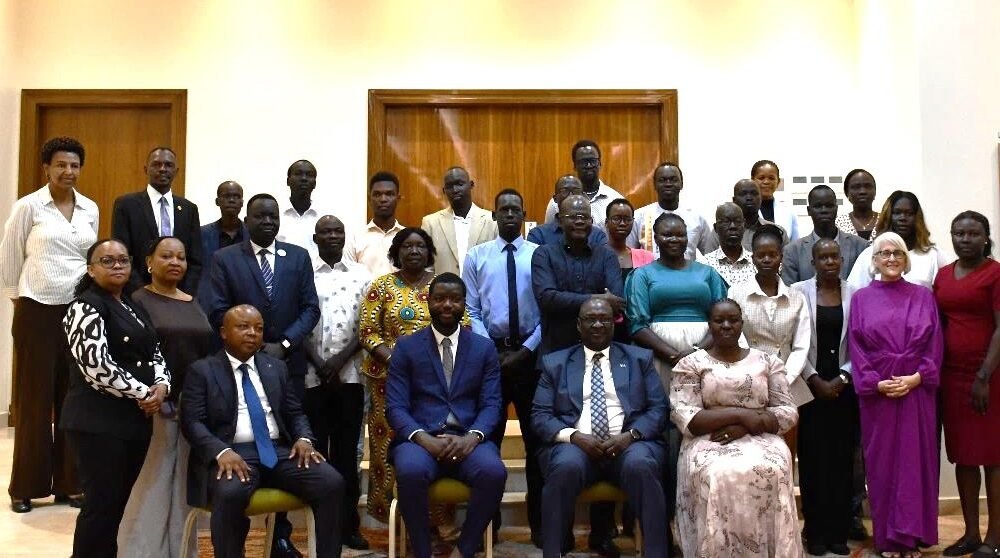
The three-day workshop brings together government institutions, international partners, civil society organisations, media representatives, academia, women and youth organisations to develop a coordinated approach to addressing harmful narratives and strengthening early warning and conflict prevention mechanisms.
Speaking during the official opening of the workshop, Dr. Riak Kok, Director General for Multilateral Affairs at the Ministry of Foreign Affairs and International Cooperation, said addressing hate speech and disinformation requires collective responsibility and cooperation among national institutions and other stakeholders.
“Combating hate speech is not the responsibility of one person or national institution alone, but it is our responsibility as a nation,” Riak said.
He noted that the proposed platform would provide an opportunity for relevant institutions and stakeholders to work together, exchange information, develop common strategies, and promote a peaceful and informed society.
Riak emphasised that while access to information is important, stakeholders must develop appropriate strategies to prevent information from being manipulated or used to create divisions within communities.
“We cannot also shy away from giving people information, fearing that they may use this information against our own society. But we have to have strategies that address the concerns of turning this good information into bad information,” Riak said.
Representing the Ministry’s leadership, Riak expressed appreciation to government institutions and international partners for supporting the initiative, describing the establishment of the platform as an important step toward strengthening national coordination, responsible communication, and public confidence in governance institutions.
The IGAD representative Dr. Victoria Anit said the initiative forms part of the regional organization’s broader commitment to conflict prevention and peacebuilding through effective early warning and early response mechanisms.
She noted that digital platforms have expanded opportunities for communication, civic participation, and access to information but have also accelerated the spread of disinformation and harmful narratives that can undermine trust and social cohesion.
Victoria said the proposed platform should bring together government institutions, civil society, media actors, academia, and development partners to strengthen information sharing and coordinated responses.
“Its purpose is not to replace existing mandates but to strengthen cooperation, information sharing, and coordinated responses to emerging challenges,” the representative said.
IGAD called on participants to prioritise a shared understanding of hate speech and disinformation, clarify institutional responsibilities, strengthen the connection between early warning and preventive action, and ensure national ownership and sustainability.
The United Nations Development Programme (UNDP), speaking on behalf of the UN partners supporting the initiative, said effective prevention requires coordinated action among institutions with different responsibilities, expertise, and relationships with communities.
Dr. Ligana Sene, senior economic governance at UNDP South Sudan, said harmful narratives could serve as early warning signs of rising tensions when they are carefully identified, assessed, and addressed before escalating into violence.
He emphasised that the proposed platform should translate information into practical action, including information verification, public communication, fact-checking, community dialogue, mediation, and referral to appropriate institutions where necessary.
Ligana also underscored the importance of national ownership, institutional capacity, and inclusive participation, particularly the involvement of women, young people, and marginalised communities.
The UN partners reaffirmed their commitment to working with the Government of South Sudan, IGAD, the African Union, and other stakeholders to support conflict prevention and peacebuilding.
South Sudan continues to pursue peacebuilding, national reconciliation, constitutional development, and preparations for elections under a complex political transition.
In this context, access to reliable information and public confidence in institutions are important to strengthening democratic participation and peaceful coexistence.
Hate speech and disinformation can aggravate existing tensions, reinforce exclusion, and undermine reconciliation efforts, particularly when political, ethnic, or other identity-based divisions are exploited.
The proposed national multi-agency coordination platform seeks to strengthen cooperation among government institutions, civil society, media organisations, academia, development partners, and community stakeholders to identify emerging risks and support timely preventive action.
The initiative is supported by the Government of South Sudan, IGAD, the United Nations Office of the Special Envoy for the Horn of Africa, UNDP, and other partners.
Its long-term success will depend on clear institutional responsibilities, adequate capacity, sustained national ownership, meaningful community participation, and respect for human rights and freedom of expression.
The three-day workshop is expected to lay the groundwork for a coordinated and sustainable national approach to countering hate speech and disinformation while advancing peace, national cohesion, and stability in South Sudan.