

By Lodu William Odiya
The United Nations Commission on Human Rights in South Sudan has warned that the country’s transitional political arrangements are being dismantled through unilateral government decisions, describing the developments as a “constitutional coup” that threatens peace and risks renewed conflict.
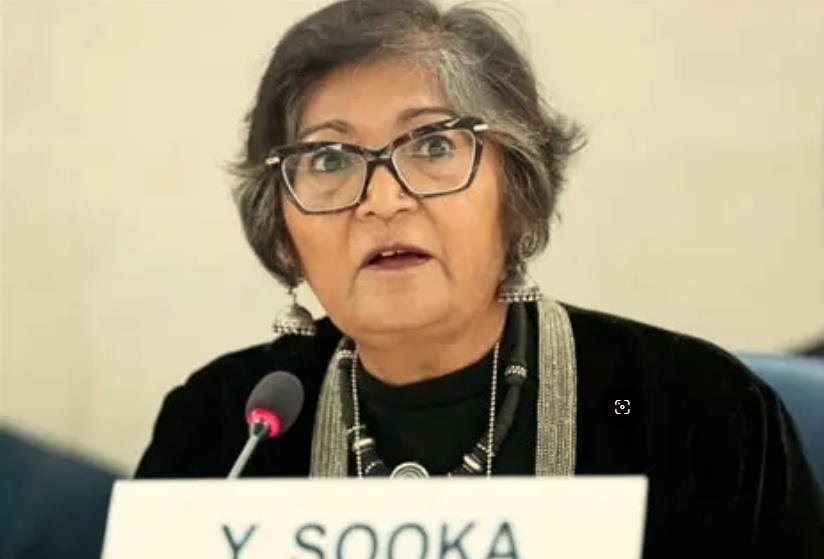
Yasmin Sooka, Chairperson of the Commission, made the remarks while presenting the Commission’s latest findings to the Third Committee of the 81st session of the United Nations General Assembly in New York.
Sooka said the political settlement established to prevent a return to war was being systematically undermined as South Sudan prepares for its first general elections.
She cited government decisions to drop the permanent constitution and national census as preconditions for elections, followed by further unilateral changes to transitional and electoral arrangements.
“These measures amount to a constitutional coup through legislative means, the unilateral removal of safeguards for inclusive power sharing and the concentration of authority in the President. The peace agreement’s supremacy formally survives, but the institutions through which it was to operate have been dismantled,” she said in her statement.
She warned that although the peace agreement formally remains in force, the institutions intended to implement it have been dismantled.
Sooka said fighting had resumed, with tens of thousands of fighters operating outside unified command, warning that elections conducted under such conditions could trigger a wider conflict.
“South Sudanese have the right to choose their leaders freely and without fear,” she said, adding that elections must not be used to undermine safeguards for inclusive governance, political competition, power-sharing and institutional oversight.
The Commission said credible elections require civic freedoms, including freedom of movement, association and expression, as well as transparent voter registration, participation of refugees and internally displaced people, and impartial electoral dispute resolution.
Sooka also highlighted the deteriorating security and humanitarian situation in parts of the country, citing military operations, aerial bombardments and ground offensives in Upper Nile and Jonglei states that have forced families to flee their homes.
The Commission warned that commanders implicated in serious violations were being integrated into state forces without proper vetting, while appointments of individuals under UN Security Council sanctions risked reinforcing impunity.
Sooka said the Commission’s August assessment had identified several factors that could contribute to atrocity crimes, including armed mobilisation, political exclusion, weakened institutions and entrenched impunity.
The Commission warned that renewed conflict in South Sudan could threaten regional stability, particularly amid the ongoing war in neighbouring Sudan and reports of Ugandan troops inside South Sudan.
To address the crisis, Sooka called for five urgent measures, including the activation of a joint African Union, Intergovernmental Authority on Development and UN task force to restore inclusive governance under the Revitalised Agreement on the Resolution of the Conflict in South Sudan.
She also called for an immediate cessation of hostilities, an end to unlawful attacks on civilians, unrestricted humanitarian access and protection for peacekeepers and human rights monitors.
The Commission further urged international partners to insist on independently assessed electoral safeguards, protect civic freedoms and ensure credible registration and dispute-resolution processes.
On accountability, Sooka called on the African Union to establish the Hybrid Court for South Sudan, support credible domestic prosecutions, preserve evidence and protect witnesses.
She also urged enforcement of the arms embargo and targeted measures against individuals responsible for serious violations and those financing them.
The Commission called for sustained humanitarian assistance, survivor support and continued independent human rights monitoring, warning that reducing these capacities as risks increase would leave civilians more vulnerable.
Sooka urged UN member states and regional partners to move beyond expressions of concern and take coordinated action to prevent further violence.
“The opportunity to prevent wider atrocities is narrowing,” she said, calling on member states to act to avert another catastrophe in South Sudan.